A Christmas tree can transform a room faster than almost any other seasonal decoration. It can also take over a small home faster than almost anything else. The problem usually is not that the tree is “too Christmas.”
It is that the tree competes with furniture that already has nowhere else to go. In a compact living room, one extra object affects:
- the walkway
- the sofa
- side tables
- curtains
- dining chairs
- TV sightlines
- floor space
So the goal is not simply to find the smallest Christmas tree possible. A tiny tree can still look awkward if it is placed badly. A slightly larger tree can work beautifully if:
- its footprint is narrow
- it uses an underused corner
- nearby furniture is edited
- the ornament palette is controlled
- the room is allowed to breathe around it
The better question is:
How do you let the Christmas tree become the main seasonal moment without making the room harder to use?
These twelve ideas focus on exactly that balance.
1. The Slim Corner Tree
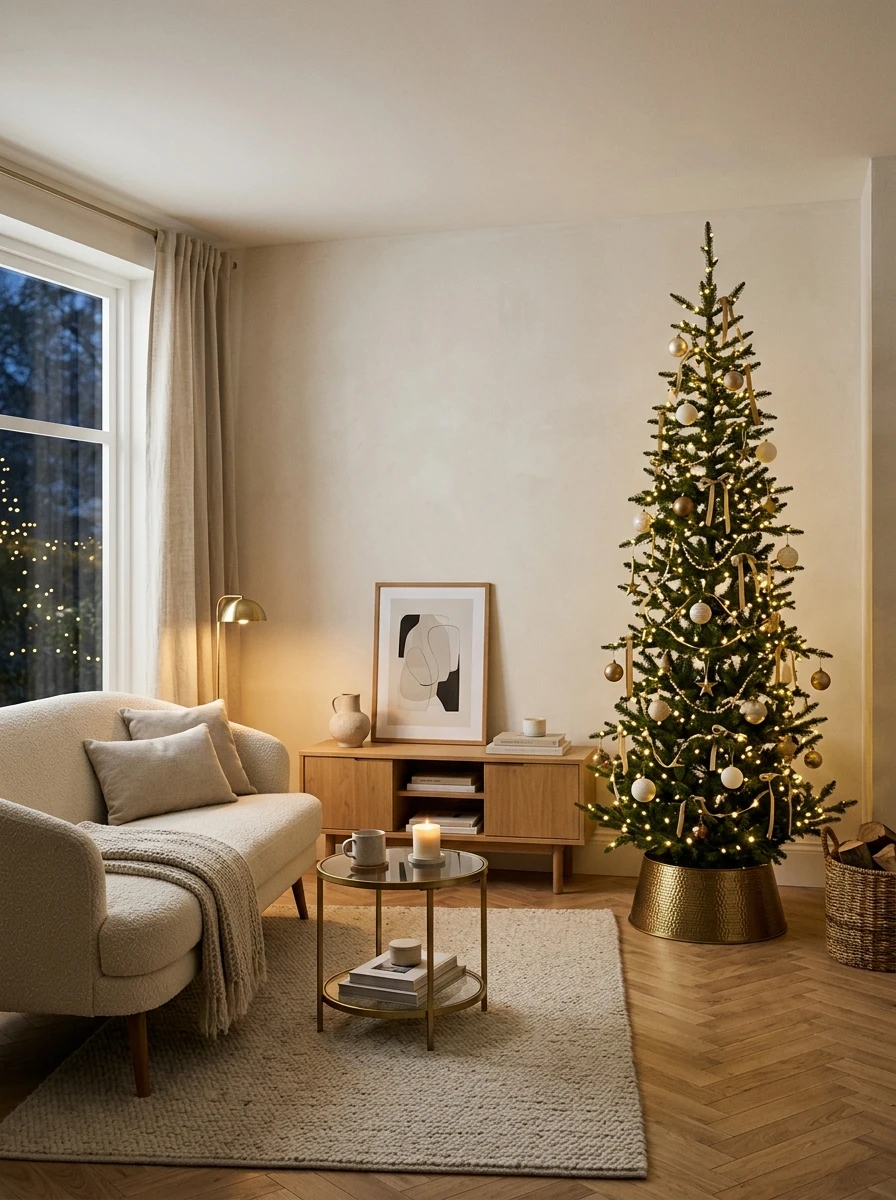
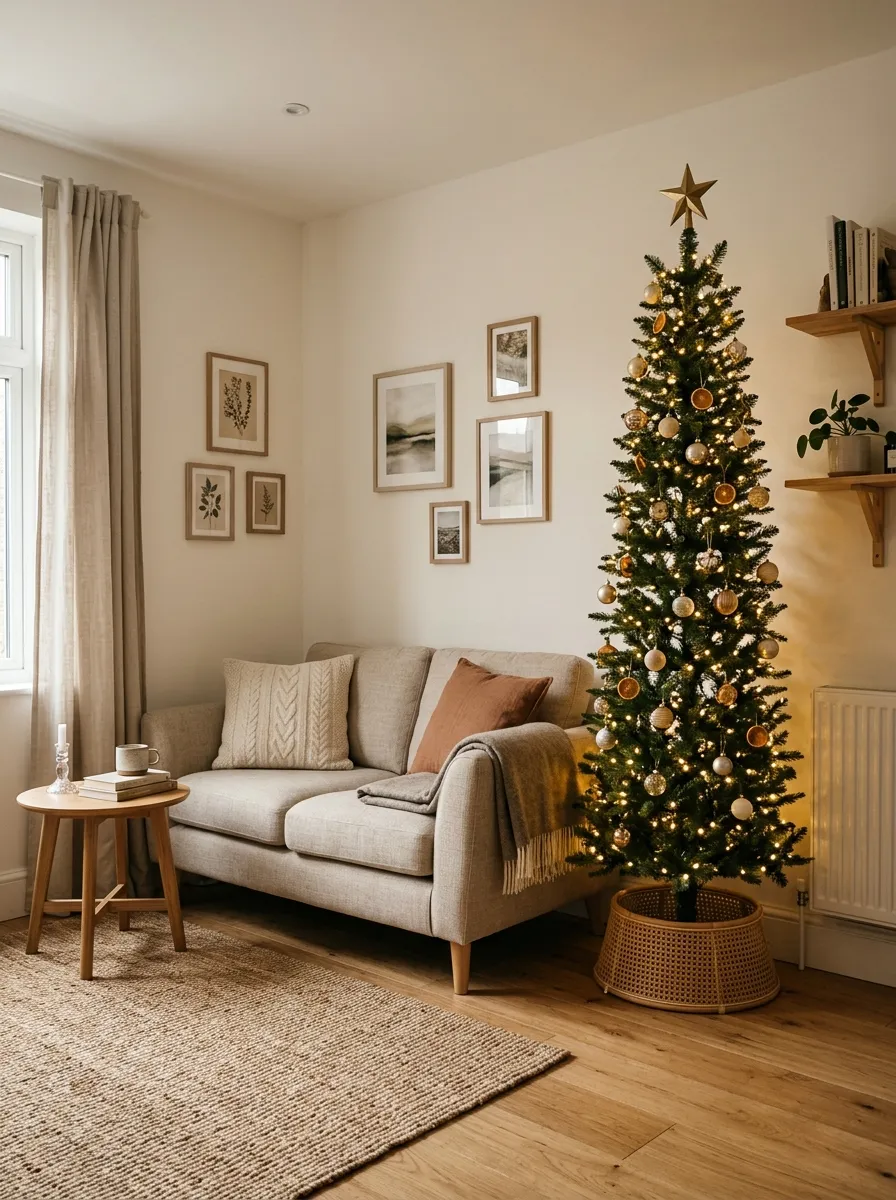
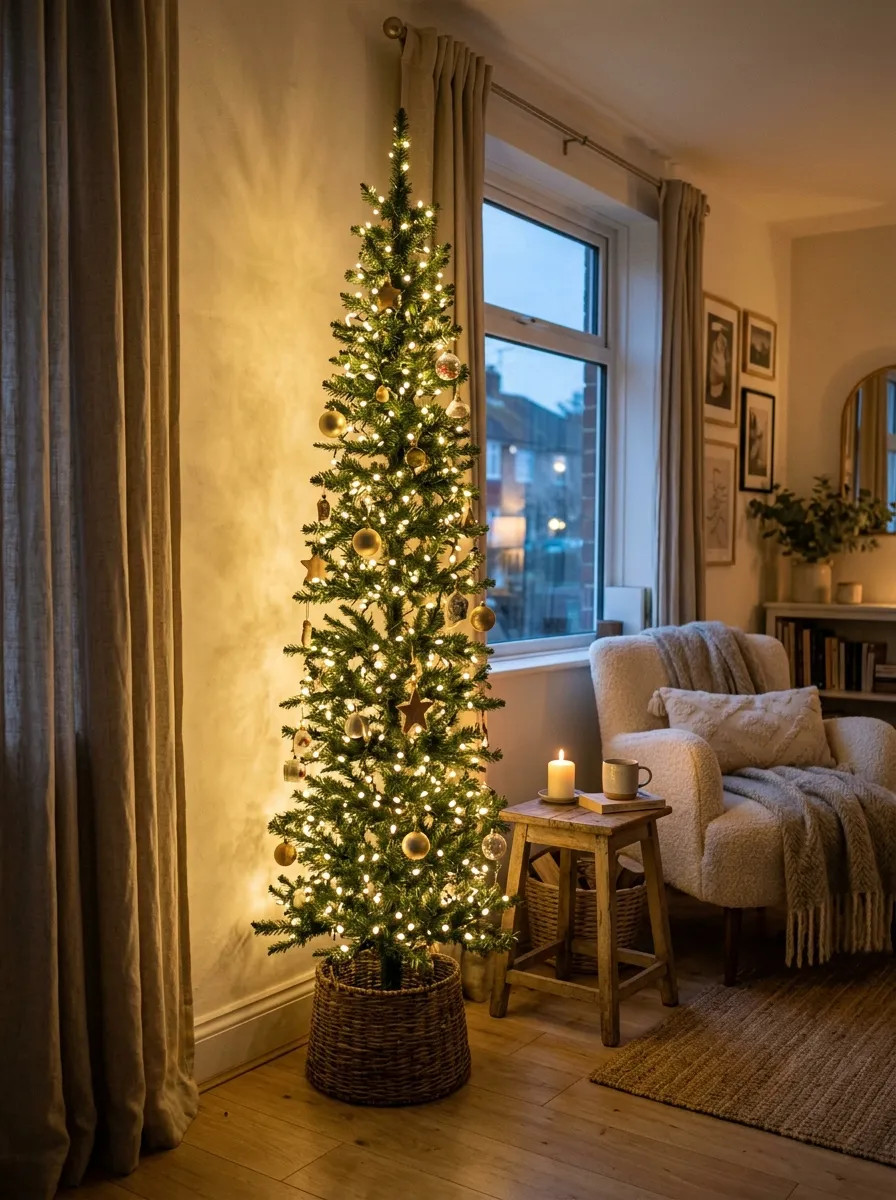
The easiest way to fit a full-height tree into a smaller room is often to reduce its width, not its height. A narrow tree can still create the vertical presence people associate with Christmas while taking up much less floor.
Why height still matters
A very short tree may save space but can lose the dramatic effect you wanted in the first place. A taller slim tree gives you:
- a real focal point
- room for lights
- meaningful vertical presence
without spreading across several feet of floor.
Choose the right corner
The best corner is usually one that is already underused. Good candidates include:
- beside a sofa
- beside a media unit
- between a window and wall
- near the dining area
Avoid corners that are important for:
- door swing
- heating
- curtain movement
- everyday circulation
Do not push it tightly into the wall
A little breathing room around the tree makes it look intentional rather than squeezed in.
Keep the base compact
A huge tree skirt can erase the space-saving benefit. Use:
- small fabric tree collar
- narrow woven basket
- restrained skirt
2. The Elevated Tabletop Tree
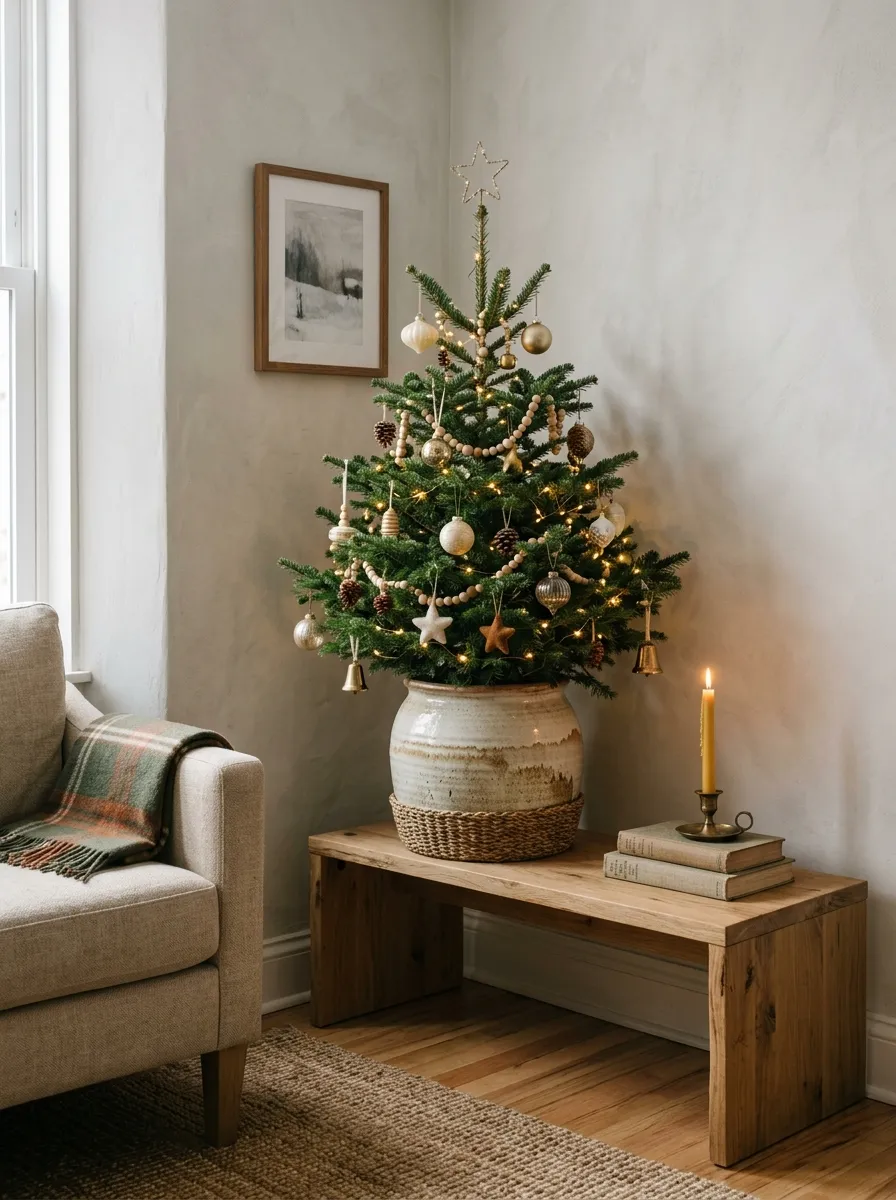
A tabletop tree can feel much more substantial when it is intentionally elevated. Instead of placing a miniature tree randomly on a table, use an existing:
- console
- sideboard
- chest
- low cabinet
as the base.
Why this works
Elevation gives the tree more presence. A three-foot tree placed on a low console can visually occupy the room more like a larger tree while using almost no additional floor space.
Use a substantial container
A tiny plastic pot can make the tree look temporary. Try:
- ceramic planter
- woven basket
- simple fabric-wrapped base
Keep the console surface edited
If the tree already occupies most of the surface, remove:
- extra lamps
- stacks of decor
- seasonal figurines
for December.
Let the tree own the area
One tree plus one restrained supporting detail is enough.
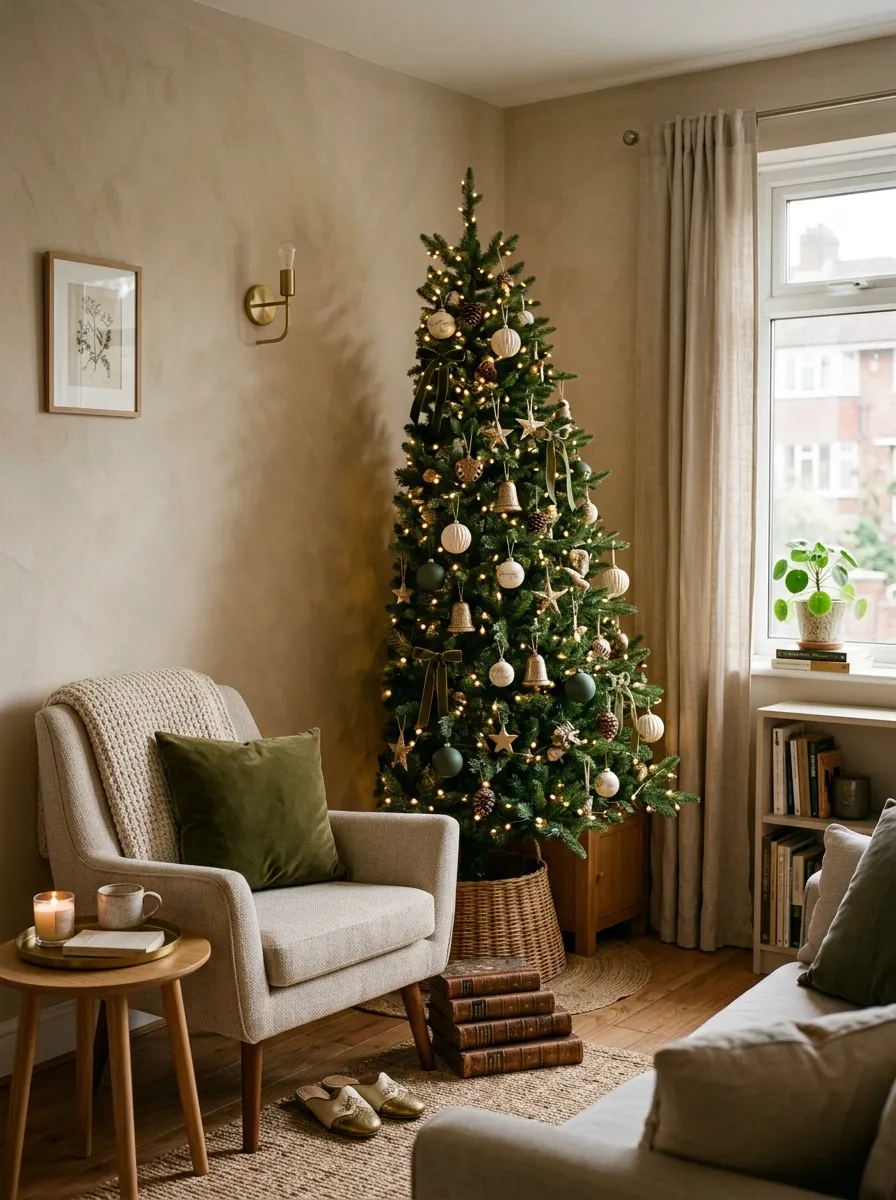
3. The Wall-Hugging Half Tree
When the room has almost no spare depth, a half-profile tree can be surprisingly practical. It gives the visual impression of a complete tree from the front while staying flatter against the wall.
Where it works best
Use it against:
- blank living room wall
- wall beside TV area
- short wall near entry
Why it feels bigger than it is
The front-facing silhouette still reads as:
Christmas tree
even though the back half is missing.
Keep styling front-focused
Concentrate:
- ornaments
- lights
- ribbon
where they can actually be seen.
Do not compensate by overdecorating
A space-saving tree should not become visually heavier just because its physical footprint is smaller.
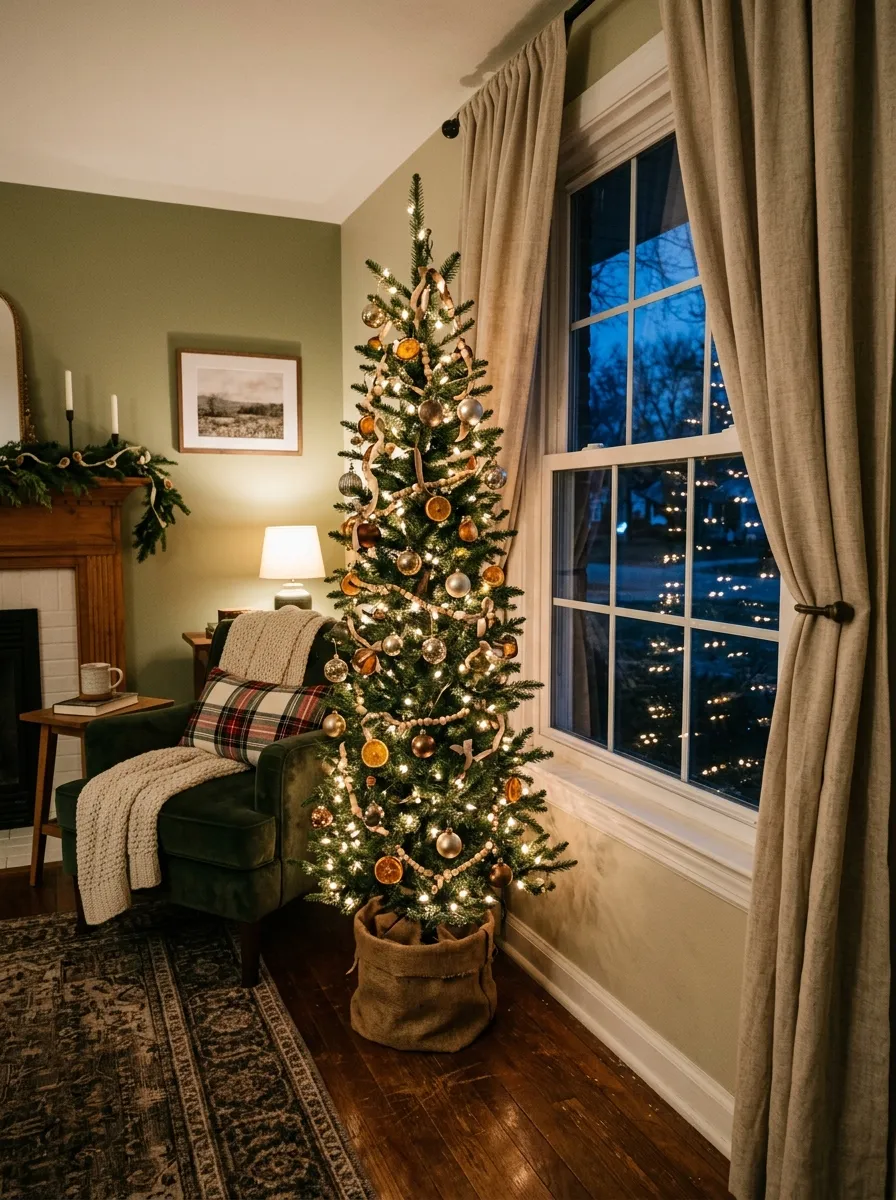
4. The Window-Side Christmas Tree
A tree beside a window can feel especially festive because it catches:
- daylight
- reflection
- evening glow
But it needs careful placement.
Keep curtain movement available
Do not place the tree where it traps:
- curtains
- blinds
- window handles
Let natural light work with it
During the day, the tree can feel lighter and less visually dense when positioned near a bright window.
At night, reflections add depth
A lit tree beside glass can appear more substantial without needing more decor.
Keep window access practical
If the window is regularly opened, leave enough room to use it.
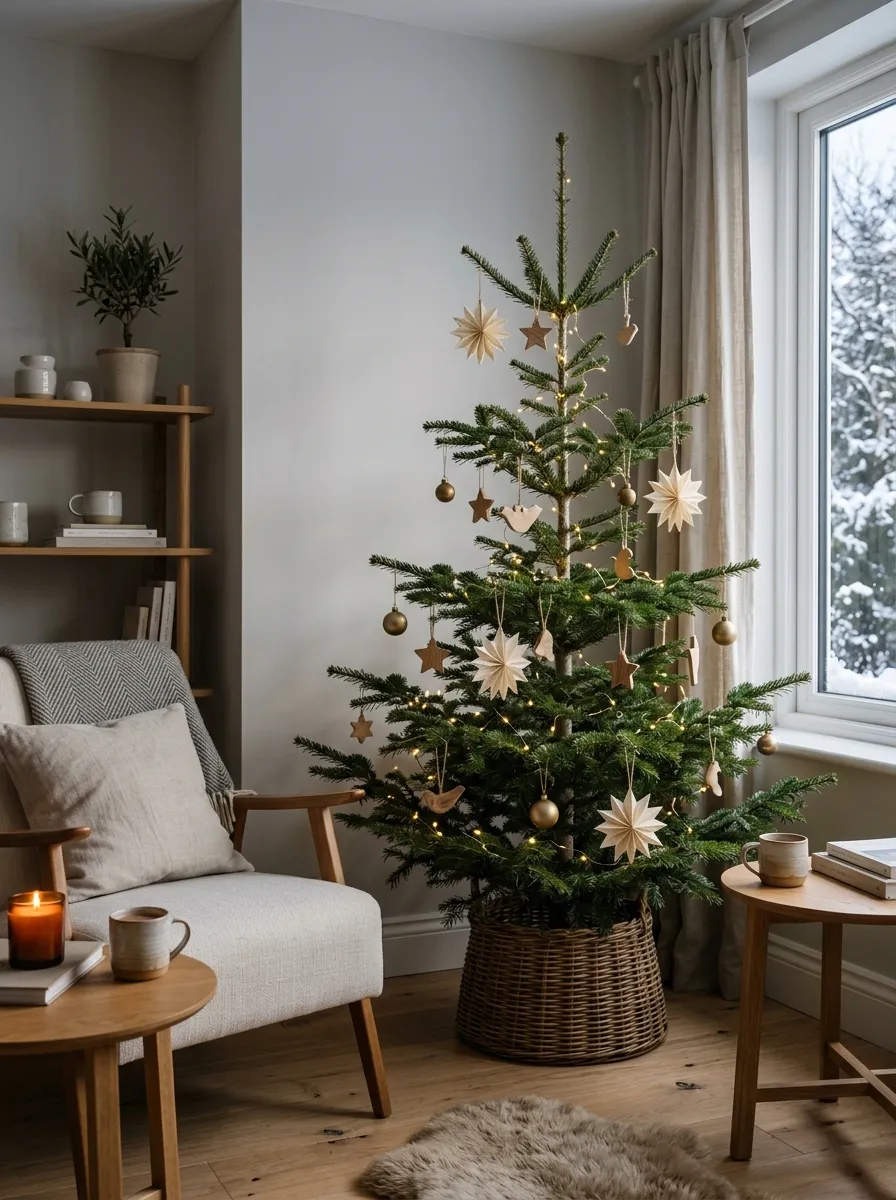
5. The Sparse Scandinavian Tree
One way to reduce the visual weight of a Christmas tree is to choose a more open, sparse structure. A tree with visible space between branches can feel much lighter in a compact room.
Why it works
Dense trees create a large solid visual mass. Sparse trees allow you to see:
- wall
- window
- room color
through the branches.
Use fewer ornaments
This style works best with restraint. Try:
- warm lights
- wood ornaments
- paper stars
- matte glass baubles
Let branch shape show
Do not cover every branch tip. The openness is part of the design.
Best for
This works especially well in homes with:
- neutral interiors
- natural wood
- minimal decor
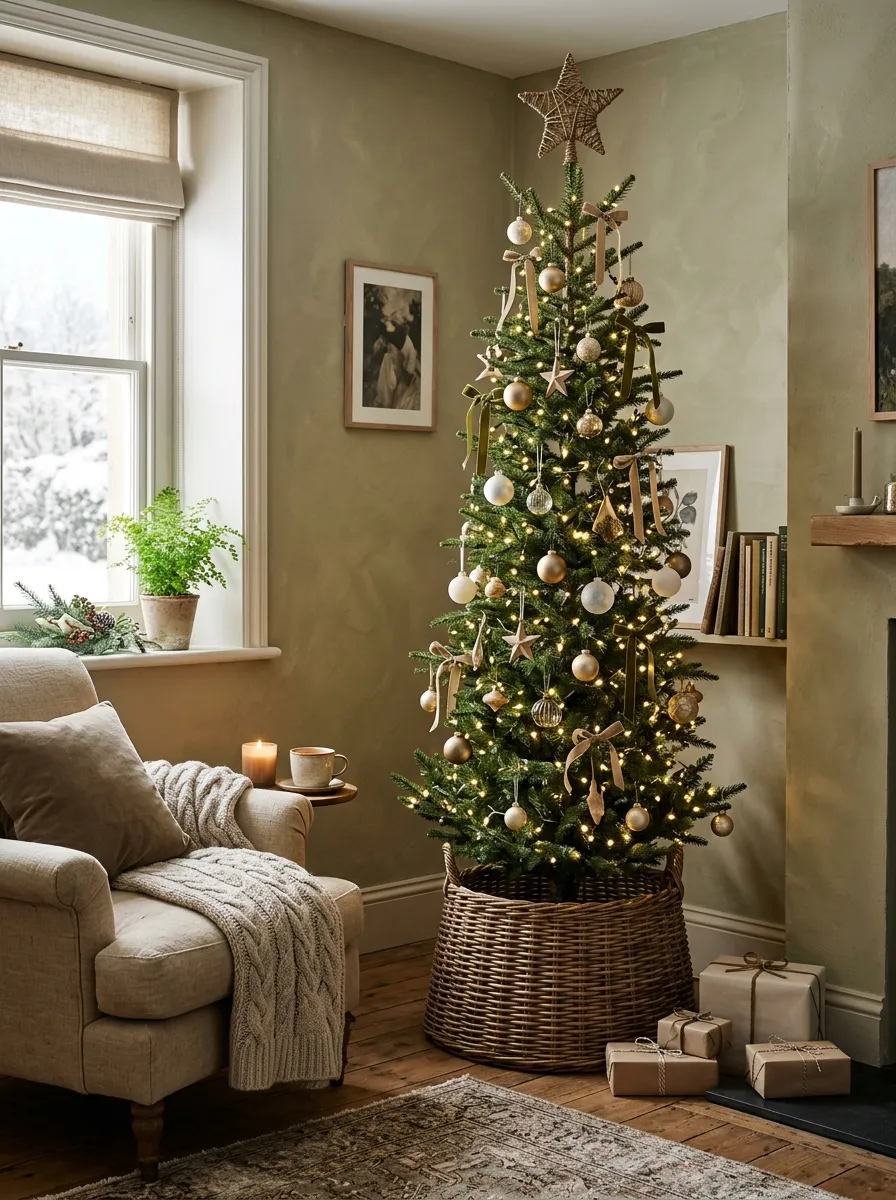
6. The Basket-Raised Tree
Raising a tree slightly can make it feel taller without increasing the footprint. A sturdy decorative container or appropriate raised base can visually lift the tree.
Why elevation helps
A tree that starts slightly above floor level gains:
- height
- presence
- visibility behind furniture
without requiring a wider tree.
Use the base as part of the design
A woven basket can visually connect the tree with:
- natural wood
- warm textiles
- neutral decor
Do not create an unstable platform
The tree needs to remain secure and stable. Use only a setup suitable for the actual tree and follow the stand or tree manufacturer’s guidance.
Avoid oversized baskets
The container should not become wider than the tree itself by a large margin.
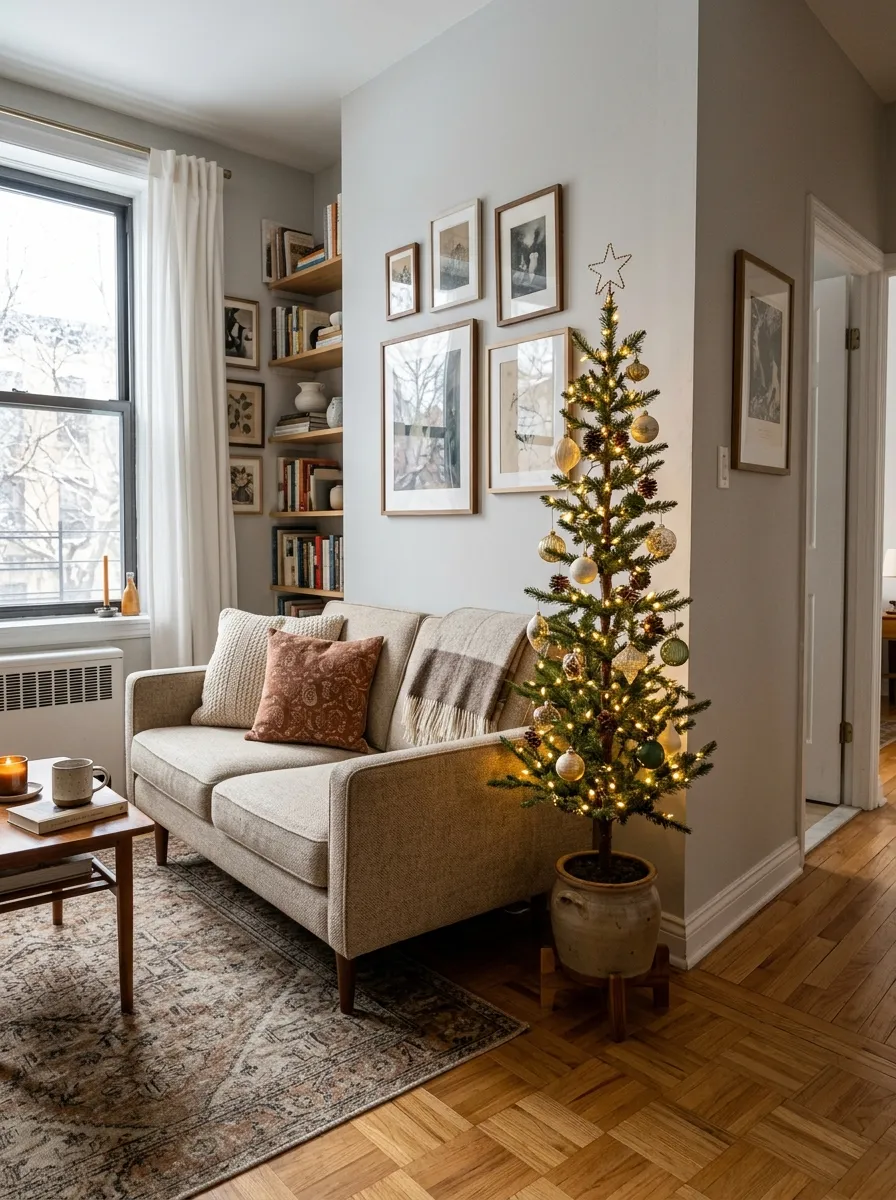
7. The Sofa-End Tree Placement
The end of a sofa is often one of the best places for a Christmas tree in a small living room. Why?
Because the area may already function as visual dead space.
Replace something instead of adding something
If there is normally:
- floor lamp
- plant
- side table
beside the sofa, consider moving it temporarily. Then the tree occupies an existing furniture zone rather than a new one.
Keep access to the sofa
Do not let branches make one end seat difficult to use.
Use the sofa as a scale reference
A tree slightly taller than the sofa area can feel balanced without dominating the ceiling.
Protect the walkway
This works best when the sofa end is not part of the main path through the room.
8. The Dining-Corner Christmas Tree
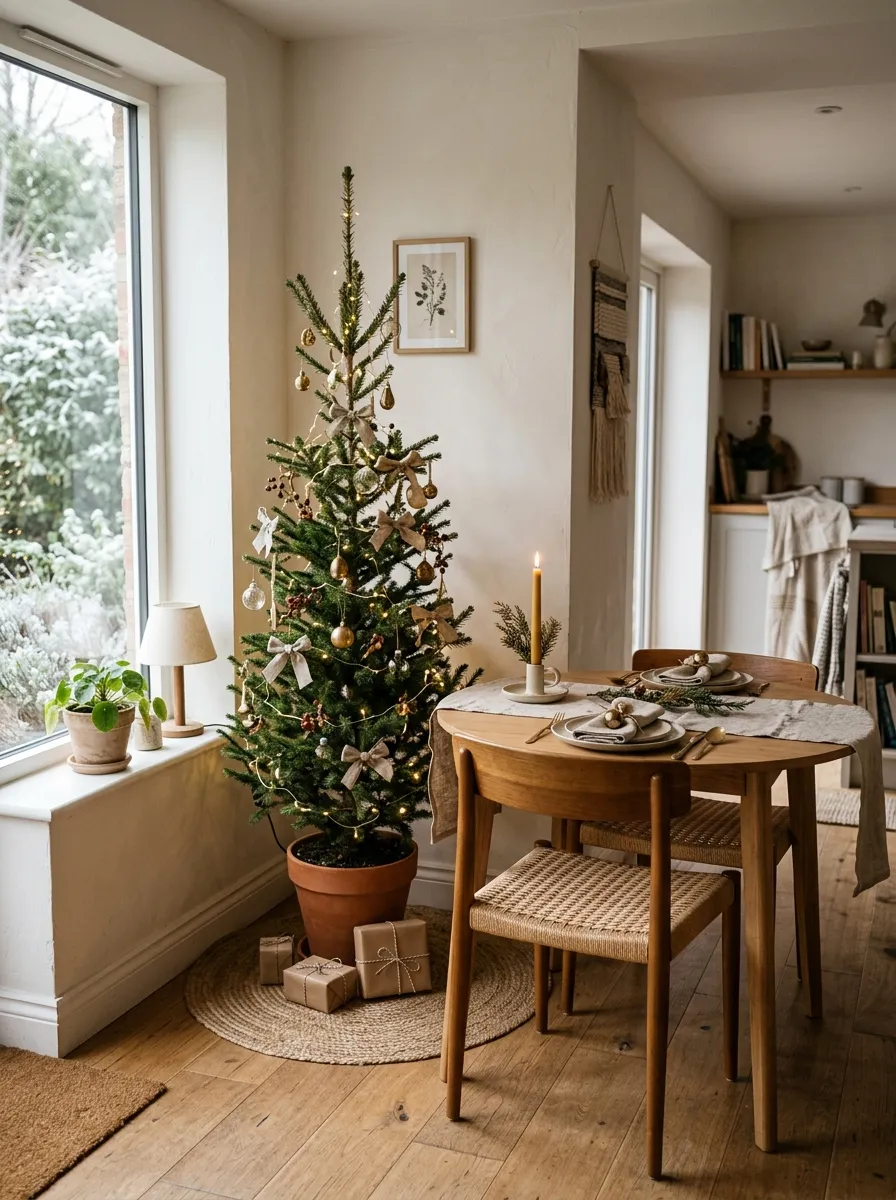
If the living room is too tight, the dining area may offer a better seasonal corner. A small tree can sit near:
- dining nook
- sideboard
- corner wall
without interfering with sofa circulation.
Keep dining chairs usable
Do not place the tree where a chair has to be pulled into it.
Use a narrower side of the room
Dining corners often have underused wall space that does not need a full piece of furniture.
Coordinate the palette
If the table uses:
- linen
- brass
- evergreen
repeat those elements on the tree.
Avoid turning the dining zone into a second Christmas display
The tree can be the main feature.
You do not also need:
- garland
- centerpiece
- lanterns
- multiple wreaths
in the same small area.
9. The One-Furniture-Out Christmas Reset
Sometimes the best Christmas tree strategy is not buying a smaller tree. It is temporarily removing one piece of furniture. This is one of the most practical options in a small home.
Look for something nonessential
Potential candidates include:
- accent chair
- side table
- large plant
- floor lamp
- decorative stool
If it is not used every day, it may not need to stay for December.
Why this works
Instead of squeezing the tree into an already finished layout, you make room for it. That creates a more intentional result.
Store the displaced piece elsewhere temporarily
Possible options include:
- bedroom
- office
- storage room
depending on your home.
Do not remove essential seating
The room still needs to work. The goal is to remove redundancy, not function.
10. The Tonal Ornament Tree
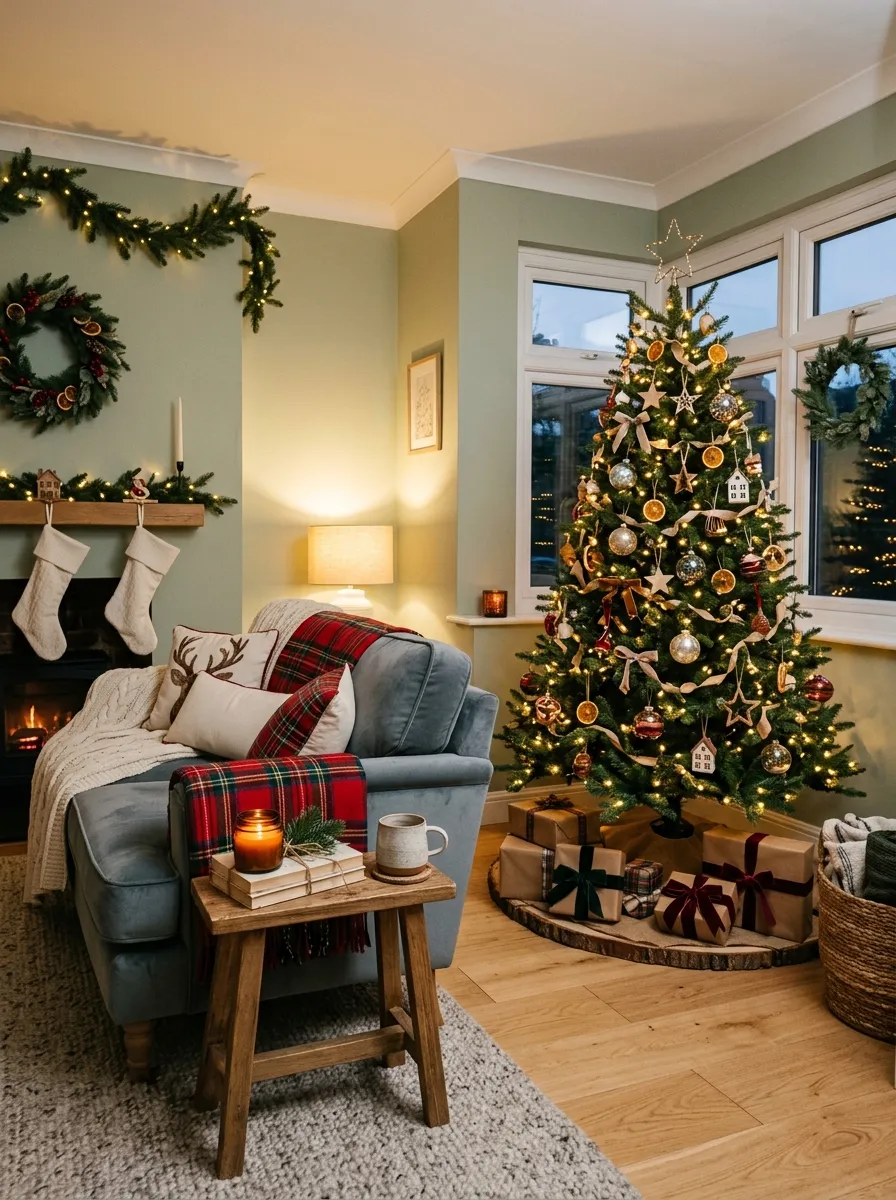
A small room can feel busier when a tree introduces too many new colors. One way to control that is to use a tonal ornament palette.
Choose two or three tones
For example:
cream + warm gold + deep green or:
cranberry + brass + natural wood or:
white + silver + soft blue
Why tonal styling helps
The tree still feels festive, but it does not become a highly contrasted visual object fighting with:
- sofa
- art
- rug
- curtains
Mix finishes, not colors
Add variety through:
- matte
- glass
- wood
- velvet
instead.
Repeat one room color
If the room already contains:
- olive
- rust
- navy
use a subtle version of that tone on the tree.
11. The Layered-Light Tree
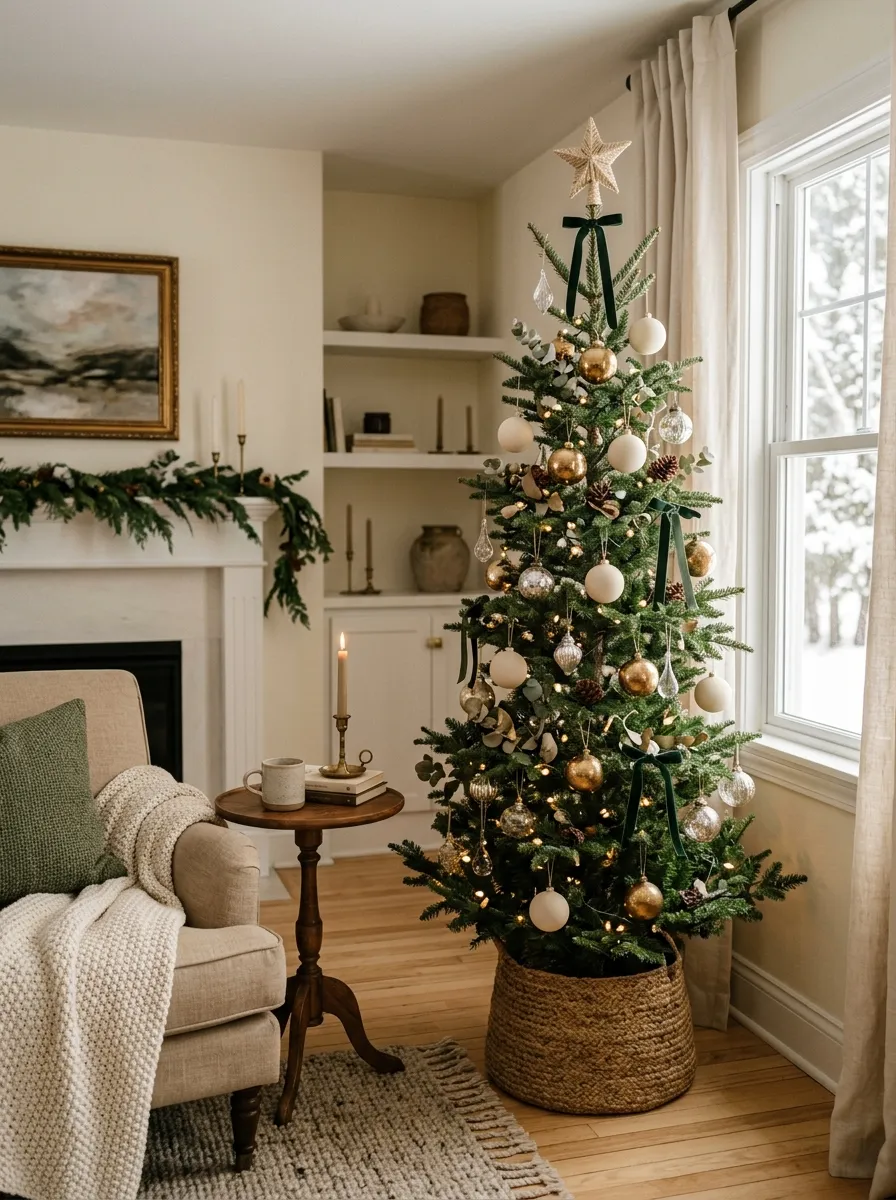
In a small home, lights can sometimes do more than ornaments. A tree with beautiful lighting can feel complete even when the physical decoration is minimal.
Build the glow first
Before adding ornaments, assess the tree with lights only. You may find that it already has enough presence.
Keep the light temperature consistent
Warm-white lighting usually integrates well with cozy interiors. Avoid mixing:
- blue-white
- warm-white
- multicolor
unless that is deliberately part of the look.
Use fewer ornaments
A well-lit tree can handle a more edited ornament collection.
Let the glow reach the room
Position the tree where it can softly illuminate:
- nearby wall
- curtain
- floor
This creates atmosphere beyond the actual tree footprint.
12. The Tree-as-the-Only-Focal-Point Formula
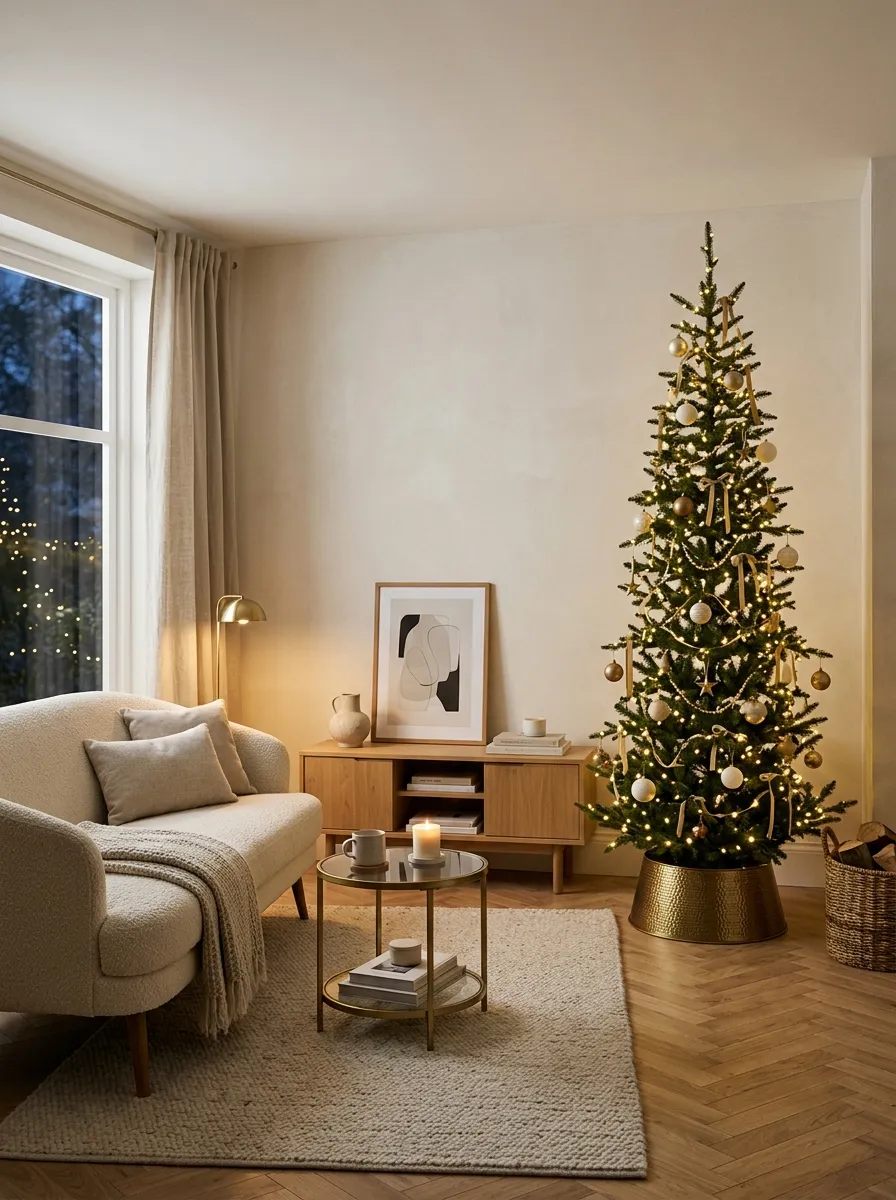
The easiest way to make a Christmas tree work in a small home may be to let it do more and let everything else do less. Instead of adding seasonal decor across every surface, let the tree become the primary Christmas statement.
Keep nearby furniture quiet
For example:
Sofa
One seasonal cushion.
Coffee table
Almost clear.
Media unit
Normal decor.
Tree
Main event.
Why this makes the tree feel larger
The eye is not competing with five other Christmas displays. One focused seasonal moment often feels more impactful.
It also reduces clutter
You do not need:
- garland everywhere
- tabletop trees
- floor lanterns
- multiple signs
- decorative gift stacks
Small spaces benefit from hierarchy
The room needs to know what the focal point is. At Christmas, that can simply be the tree.
Start With the Room Layout Before Choosing the Tree
Do not choose the tree first. Look at the room and identify:
- main walkway
- sofa edge
- door swing
- window access
- dining-chair movement
- TV sightline
Then find the zone that can change for Christmas.
Measure the Tree at Its Widest Point
Height gets most of the attention. In a small room, width is often the more important measurement. A tree may fit perfectly vertically but still crowd:
- furniture
- walkway
- curtains
because its lower branches spread too far.
Measure the Base Too
Check the full footprint of:
- stand
- collar
- basket
- skirt
A compact tree with an oversized base can create the same floor problem.
Test the Tree Position With Painter’s Tape
Before bringing the tree home, mark the approximate footprint on the floor. Then:
- walk past it
- open nearby doors
- pull out chairs
- sit on the sofa
If the taped footprint already feels intrusive, choose another placement or narrower tree.
Use Height Where You Have It
A small room does not necessarily require a short tree. If ceiling height is normal and the footprint is narrow, a taller slim tree can often look better than a short wide tree.
Protect the Main Walkway
The tree should sit beside circulation, not inside it. This becomes especially important when carrying:
- laundry
- groceries
- packages
through the room.
Keep Branches Away From Doors
A tree that brushes the door every time it opens will become frustrating very quickly. Test:
- front door
- balcony door
- closet door
near the proposed position.
Keep Curtains Functional
Do not trap curtains behind the tree if you still need to:
- open them
- close them
- access blinds
Leave enough room to use the window normally.
Consider the TV Sightline
A tree placed beside or partly in front of a TV may look fine while standing. Then you sit down and discover half the screen is blocked by branches. Check from the sofa.
Watch Heating and Heat Sources
Keep trees and decorations appropriately positioned away from:
- heaters
- radiators
- fireplaces
- heat-producing fixtures
and follow the relevant product and fire-safety guidance.
Real Tree vs Artificial Tree in a Small Home
Both can work.
Artificial
Can make it easier to choose a very specific:
- width
- height
- silhouette
such as a slim tree.
Real
Offers natural irregularity and texture, but shape and width can vary substantially. For either one, stability and safe placement matter.
Slim Tree vs Short Tree
Slim tree
Best if you have:
- vertical height
- narrow floor zone
Short tree
Best if you have:
- console
- table
- sideboard
- low ceiling limitation
A small room does not automatically mean you need both short and narrow.
Full Tree vs Sparse Tree
Full tree
Creates stronger traditional presence.
Sparse tree
Feels visually lighter and lets more of the room show through. In compact interiors, sparse can sometimes feel more sophisticated.
Do You Need a Tree Skirt?
Not necessarily. A large skirt can spread across valuable floor. Try:
- fitted fabric collar
- woven basket
- small tailored skirt
instead.
Avoid Fake Gift Piles Around the Tree
They look attractive in styled photographs. In a small home, decorative presents consume useful floor space for weeks. Let real gifts appear naturally as Christmas approaches.
Keep the Tree Base Easy to Clean Around
Pine needles, dust and ornament debris gather around the base. Do not create a base styling system that requires moving:
- baskets
- lanterns
- decorative boxes
every time the floor needs cleaning.
Use Fewer, Larger Ornaments
Ten medium ornaments may have more impact than thirty tiny ones. This can keep a small tree from looking visually busy.
Do Not Fill Every Branch
Visible greenery creates breathing room. A tree does not need an ornament on every available tip.
Repeat Materials From the Room
If the room already has:
- oak
- linen
- brass
- black metal
bring one or two of those materials into the tree. This helps it belong to the room rather than looking like a separate themed object.
Let the Tree Replace Decor
If a tree sits beside a console, remove some of the console decor. If it replaces a plant, move the plant. If it sits near artwork, you may not need extra wall garland.
Seasonal decorating works better when it substitutes rather than only adds.
Small Living Room Christmas Tree Formula
Try:
Tree
Slim, full height.
Placement
Sofa end or corner.
Furniture change
Remove one side table or plant.
Styling
Warm lights + limited ornaments.
Studio Apartment Christmas Tree Formula
Try:
Tree
Sparse slim tree.
Placement
Beside window or at living-zone edge.
Other Christmas decor
Minimal. Because almost the entire studio is visible at once, too many seasonal zones can become visually noisy.
Small Dining-Living Room Formula
Try:
Tree
Dining-side corner.
Living room
Keep normal arrangement.
Table
One simple seasonal detail. This keeps the tree from interfering with sofa circulation.
Very Tiny Home Formula
Try:
Tree
Tabletop.
Base
Existing console or cabinet.
Height
Use elevation to create presence. No additional floor footprint required.
Minimal Christmas Formula
Try:
Tree
Sparse.
Lights
Warm white.
Ornaments
One tonal palette.
Other decor
Almost none.
Traditional Christmas Formula
Try:
Tree
Slim but full.
Palette
Cranberry + warm gold + evergreen.
Lighting
Warm.
Base
Small tailored skirt or collar. Traditional does not require oversized.
A Modern Christmas Formula
Try:
Tree
Sparse or medium-full.
Palette
Cream + black + brass.
Ornaments
Fewer, larger pieces.
Surroundings
Clean surfaces.
Common Small-Home Christmas Tree Mistakes
Buying by height only
Width often causes the real problem.
Choosing a tree before choosing its location
Room first, tree second.
Keeping every piece of normal furniture
Sometimes one piece should temporarily leave.
Oversizing the tree skirt
The base footprint matters.
Blocking curtains
Keep windows functional.
Blocking the main walkway
Never sacrifice daily movement for styling.
Filling the tree with too many colors
The tree can visually overwhelm a compact room.
Adding Christmas decor everywhere else too
Let the tree be the focal point.
Using a tiny tree just because the room is small
A taller narrow tree may actually look better.
Forgetting how the tree looks from the sofa
Always test the main sitting viewpoint.
The Furniture Reset Before the Tree Goes Up
Before decorating, remove all small movable pieces from the proposed tree area. That might include:
- plant
- stool
- side table
- basket
Then place the tree. Afterward, add back only the pieces the room still needs. This is much easier than trying to squeeze the tree into the existing arrangement.
A Simple Tree Size Test
Ask three questions:
1. Can I walk past it normally?
If not, it is too wide or badly positioned.
2. Can I still use nearby furniture?
If not, something needs to move.
3. Does the tree feel intentionally placed?
If it looks wedged between objects, reconsider the location.
Which Christmas Tree Idea Fits Your Home?
Choose the Slim Corner Tree if:
You want a full-height traditional tree with a smaller footprint.
Choose the Elevated Tabletop Tree if:
You have almost no spare floor space.
Choose the Half Tree if:
Depth is the main limitation.
Choose the Window-Side Tree if:
You have a bright unused corner.
Choose the Sparse Tree if:
The room already contains a lot of visual detail.
Choose the Basket-Raised Tree if:
You want more vertical presence from a compact tree.
Choose the Sofa-End Placement if:
A plant or side table can temporarily move.
Choose the Dining-Corner Tree if:
The living area cannot spare another footprint.
Use the Furniture-Out Reset if:
The room feels crowded before the tree even arrives.
Choose Tonal Ornaments if:
The tree is visually overwhelming the rest of the room.
Choose Layered Lighting if:
You want atmosphere with fewer physical decorations.
Use the Tree-as-Focal-Point Formula if:
You want the whole room to feel Christmasy without decorating every surface.
Final Thoughts
The best Christmas tree for a small home is not necessarily the smallest tree. It is the tree that works with the room instead of fighting it. Start with the layout.
Find the corner, wall or furniture zone that can change for December. Then choose the tree based on:
footprint → height → visual weight not height alone.
Move one nonessential piece of furniture if that creates a better result.
Use fewer ornaments when the room already contains a lot of detail. Let lighting do more. Keep the base compact.
And consider letting the tree be the room’s main Christmas statement instead of adding seasonal decor to every surface. A small home can still have a Christmas tree that feels generous and memorable. It just needs to take up the right kind of space.
- christmas tree ideas for small homes
- small christmas tree ideas
- christmas tree ideas for small spaces
- small living room christmas tree ideas
- space saving christmas tree ideas
- seasonal decor